English version
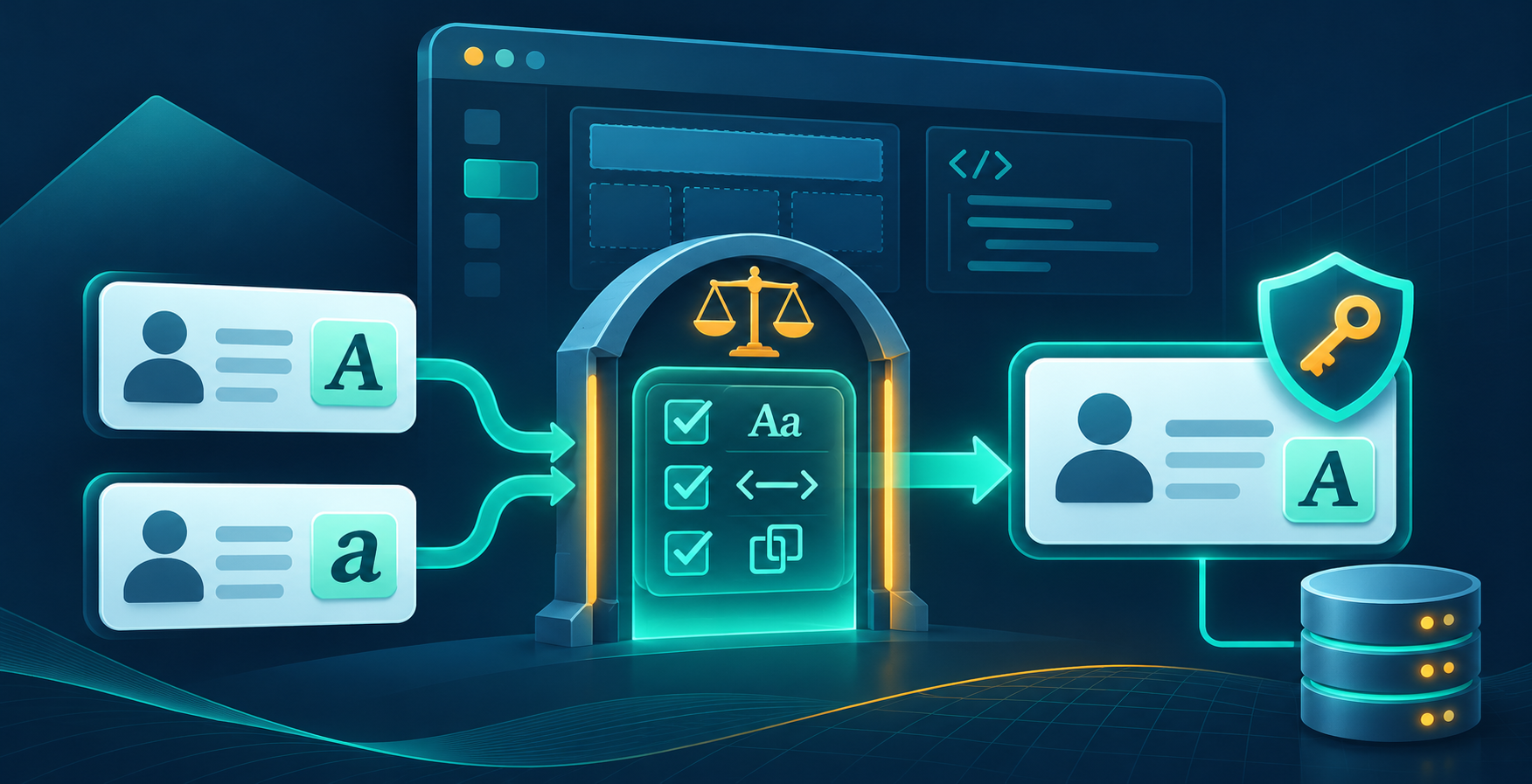
My earlier LinkedIn post explored a custom authentication function in Oracle APEX. Before implementing the password comparison, there is another design decision worth checking: what exactly identifies an account?
If Alice, ALICE, and Alice can reach the same account in one component but different accounts in another, even a correct password verifier can sit behind an inconsistent identity model. This walkthrough uses synthetic data to expose that problem before changing a login flow.
Separate the login flow from the credential verifier
An authentication scheme establishes identity; APEX then exposes the signed-in identity through APP_USER. Prefer an available preconfigured scheme when it fits your identity provider and operational requirements. Custom authentication means owning the integration and its failure paths, not only writing a Boolean function. Oracle: authentication concepts
For a username/password scheme, APEX_AUTHENTICATION.LOGIN invokes the scheme's credential check, then handles successful post-authentication processing, logging, and redirection. Its p_uppercase_username parameter defaults to TRUE. That default matters when the account repository distinguishes letter case. Oracle: LOGIN API
Run a normalization preflight with disposable data
Suppose a proposed policy treats usernames as case-insensitive and ignores surrounding spaces. This query demonstrates the resulting collisions without creating or changing a table:
with demo_users (user_id, login_name) as (
    select 101, 'Alice' from dual union all
    select 102, 'ALICE' from dual union all
    select 103, ' bob ' from dual union all
    select 104, 'BOB'   from dual union all
    select 105, 'Carla' from dual
)
select upper(trim(login_name)) as login_key,
       count(*) as matching_accounts
from demo_users
group by upper(trim(login_name))
having count(*) > 1
order by login_key;
Expected rows for these ASCII examples:
LOGIN_KEY  MATCHING_ACCOUNTS
ALICE      2
BOB        2
Those are two different account records competing for each proposed key. Resolve the ownership and migration policy before enforcing uniqueness. Do not arbitrarily select the first matching record.
This is a design probe, not a universal username rule. A tenant-specific identity may need a composite key including the tenant. International names require an explicit policy for Unicode, collation, and normalization; this ASCII demonstration does not settle those rules. Apply your chosen policy consistently to registration, lookup, recovery, and account linking.
Make APEX's case handling explicit
If your reviewed identity policy deliberately preserves case, an illustrative login-page process with existing username and password items can call:
begin
    apex_authentication.login(
        p_username           => :P9999_USERNAME,
        p_password           => :P9999_PASSWORD,
        p_uppercase_username => false
    );
end;
Adapt the item names and review the active authentication scheme before use. Put this call in the login process; the scheme's verifier supplies its credential decision. Changing the parameter alone does not migrate existing account keys or fix a conflicting lookup query. Never uppercase or trim the password to mirror a username rule.
Give password storage its own contract
A single SHA-512 hash, even with concatenated account fields, is not a modern adaptive password-storage design. Use a maintained verifier implementing a suitable password-hashing scheme such as Argon2id, with per-password salts and reviewed work factors. Retain the algorithm and parameters needed for verification and upgrades. OWASP: password storage
Define a generic user-facing failure response, controlled login throttling, recovery behavior, and appropriate multifactor authentication. Keep detailed diagnostics protected and exclude credentials from logs. OWASP: authentication guidance
Before rollout, test valid credentials, wrong passwords, unknown and disabled accounts, case variants, whitespace, duplicate normalized names, and verifier failure. Check the resulting APP_USER and account mapping. The examples above illustrate design and expected results; they do not implement a complete credential service or assert a measured performance improvement.